H₂O
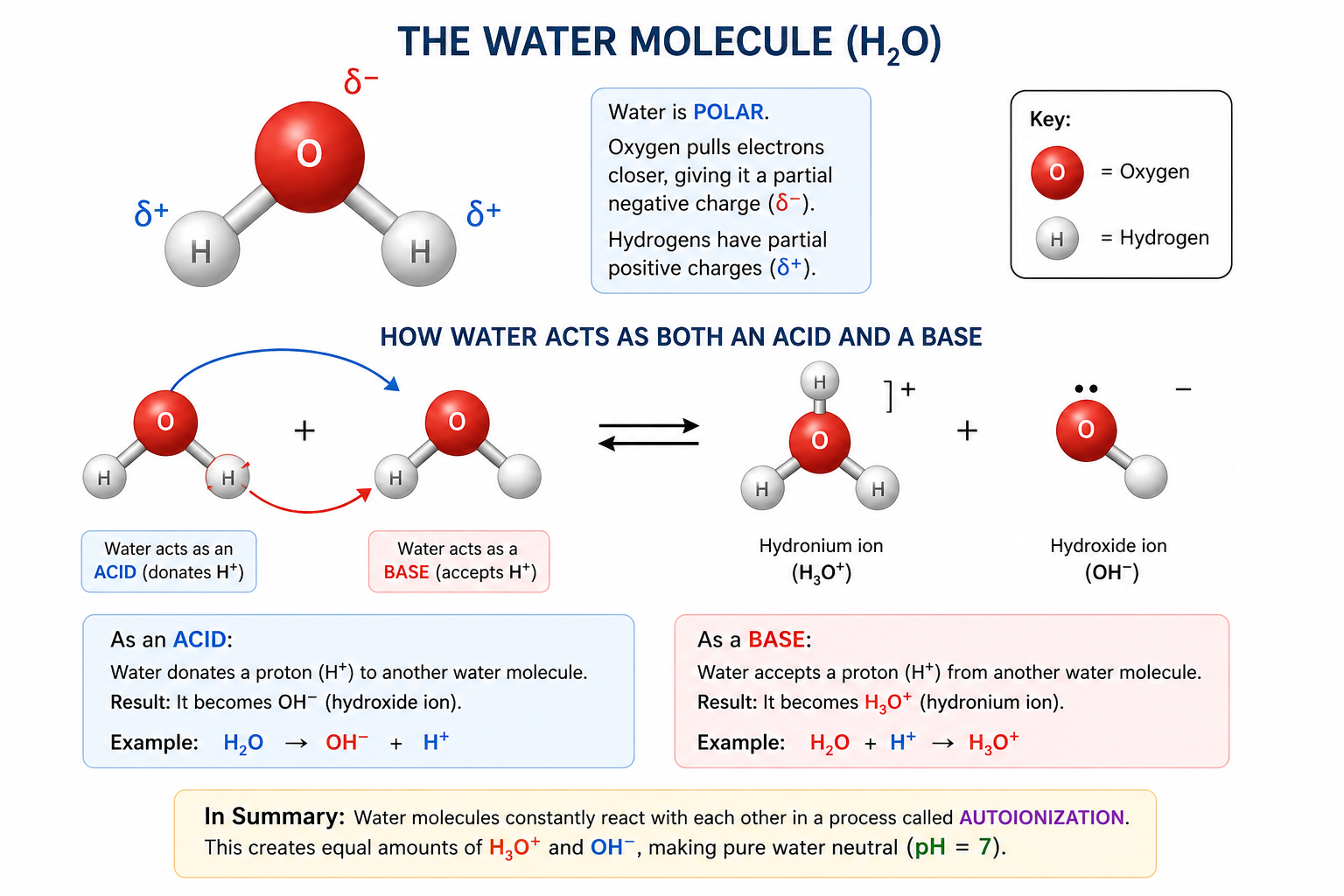
Water consists of two hydrogen atoms connected to an oxygen atom.
Explanation
Chemical Structure:
- The formula H₂O tells us that each molecule of water is made of two hydrogen (H) atoms bonded to one oxygen (O) atom.
- The atoms are arranged so the molecule has a "bent" shape, not a straight line.
Why This is Important for Acids and Bases
Water as a Solvent
- Water is known as the "universal solvent" because it dissolves many substances, including acids and bases.
- Most acid-base chemistry happens in water!
Water Self-Ionizes
- Water can ionize a little bit, splitting into hydrogen ions (H⁺, often called protons) and hydroxide ions (OH⁻):
Defining Acids and Bases
- Acids are substances that increase the concentration of H⁺ (or H₃O⁺) in water.
- Bases increase the concentration of OH⁻ in water.
- The pH scale, which tells us how acidic/basic a solution is, is based on the concentration of H⁺ in water.
Amphoteric Nature
- Water can act as both an acid and a base (amphoteric).
Buffering and Reactions
- Many chemical reactions involving acids and bases depend on water's structure and ability to donate/accept H⁺.
Summary
Significance:
Water’s unique structure (two hydrogens bonded to one oxygen) makes it the perfect environment for acid-base reactions, lets it self-ionize, and gives it the ability to act as both an acid and a base. All of this is foundational to understanding acid-base chemistry!
If you want to know more, or see how water participates in specific acid-base reactions, let me know